(Travel Tangent: Texas)
For reasons, I am thinking about a different trip a few years back.
I never listen to radio except when I am driving alone in some big sky country and then I like scratchy AM stations playing country music and screechy preachers and small-town baseball games where the play-by-play mentions guys like Gus and Jimmy and Tank. It’s a big sky drive across Texas.
I fly into Houston, pick up my rental and head west. I am headed for Marfa, home of feuding Donald Judd foundations, for the last Chinati Open House Weekend. They used to be held every year: behind-the-scenes art tours, talks, a famous band playing for free at the Thunderbird Hotel.
Marfa is a great small town with real small town people. During the open house weekends they stay home and the streets are crowded with curator types, wearing black and sporting $500 glasses designed by Dr. Seuss.
The main Chinati compound is gigantic, on an old air force base. Few artists are represented; it’s mostly a Donald Judd wonderland. Giant works are displayed outside. I go to talks and on tours.

There is a luncheon in a big hall. People tell me I must meet a lot of people when I travel. I do not. I drift in and out of places as a hobo outsider and do not join conversations or get all hidey-ho. At this lunch I do not sit anywhere near other people. I grab my grub and sit on a bench in a far corner of the hall, beside a work by David Rabinowitch, who is a cranky Dia big deal originally from Toronto and somewhere, somehow, I had met and interviewed him.
When I interview people, (which is not very often any more), if I do not like them, or do not like the way they give (or more likely don’t give) it up I stop taking notes and don’t write the story, unless I really have to. A profile piece almost always has to be a collaboration: if the subject doesn’t reveal the funny, the tragic, the eccentric, the interesting, their at-home selves, something, the writer cannot make it up. I once interviewed a woman who had written out every book of the Bible with Bic pens and placed each book in a separate Duo-tang. I was so delighted, but she had seemingly seen only interviews with politicians; she reacted with suspicion and too much care to every question, thinking I wanted only to trip her up. Great subjects are voluble. In Halifax, Dave Nauss and Ken Pinto come to mind as non-stop talkers who do not filter and edit themselves while they talk. Stuff about them writes itself. I ended up not writing about David Rabinowitch.
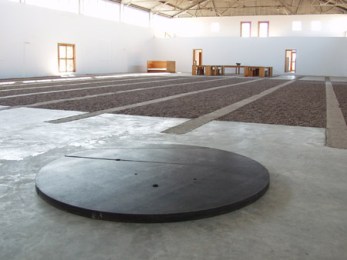
The Rabinowitch in the corner of the hall.
At the lunch a woman makes the trek to my outpost. She is elderly and elegant. “What are you doing over here all by your lonesome?” she says. “Where I come from,” I say, “I don’t get to eat sitting by a Rabinowitch often enough.” She likes this and she sits down.
I get around to telling her I am on my way to Quemado, New Mexico, to see Walter De Maria’s The Lightning Field. She likes this a lot. She introduces herself and she is Helen Winkler. I recognize her name.
Helen Winkler help found Dia Art Foundation. She traveled with De Maria in the 1970s when he was tooting around the American west looking for a place to install The Lightning Field. She helped Mark Rothko get off his ass in New York when folks were waiting for the panels that were to be installed as the The Rothko Chapel in Houston.”Whoa,” I say. “This is like meeting a movie star.” She laughs, gives me her number, and tells me to call her when I get to Houston.
The next day there is a BBQ for all and sundry, at one of Donald Judd’s ranches in the hills about 34 miles south of Marfa. Organizers recommend high clearance four-wheel drive vehicles. My rental is a compact. It’s only a recommendation, I think.
The pavement ends quickly and then it’s a never-ending turbulent bump fest down gullies and over big scraggy rocks, me jack-rabbiting in and out of the car plotting the next three feet. The scenery goes by at two miles an hour. I pull over several times to let convoys of Jeep Renegades and the like get by.
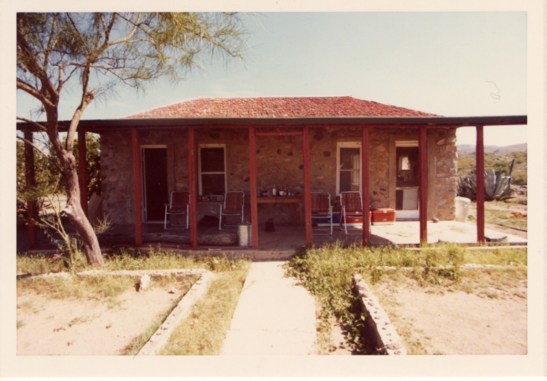
part of Ayala de Chinati, a Judd ranch
I finally get there. The arrivées already have full plates and cups and are laughing and carrying on at wood banquet tables under open-air wood sheds. A Mexican quartet plays. I eat some corn and beans and hang out a while, looking at a bath house Judd built. And then head south, further away from Marfa, to the beautiful Highway 170, into Big Bend National Park, and circle around back to town. This takes hours.
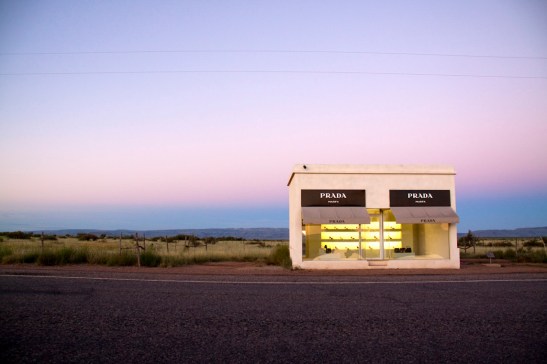
The next day there are tours all over town, to offices, residences, galleries and studios. When I leave, I drive west out of Marfa. It is evening turning to night. I have seen many wonderful works of art. Been to places usually not accessible to the public. I am glad it is over. So many people. Sonic Youth played for free but I didn’t go. The road is so open, the land is so wide, the sky is so big. Although the day is ending it feels full of possibilities. Up a ways on the left there is light and when I get to it I see it is more art: Prada Marfa. It is so beautiful in the lessening light.
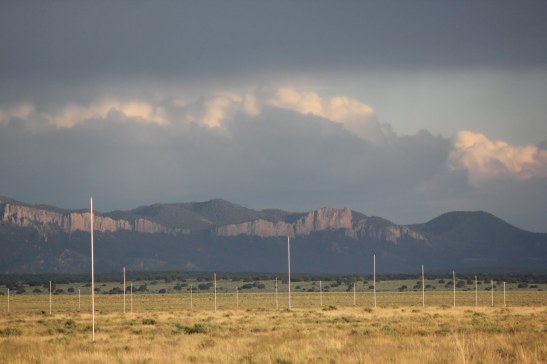
The Lightning Field is 400 tall pointy stainless steel poles, installed outside in a grid one mile by one kilometer. There is only one way to see it: to make a reservation, pay a chunk of money, and go stay there overnight. You park your car in Quemado and are driven on unmarked roads, through fenced-off fields, along private trails and dropped off at a cabin in the true middle of nowhere. You cannot take your own car. Everything about it is perfect, and I do not say this lightly.

The power line to the cabin is buried. The beds, linens, tableware, furnishings, everything, has been chosen with great care, to be as simple as possible. Supper and breakfast for six (the maximum number of people who can visit at one time) are in the fridge. There are six plates in the cupboard and six forks in the drawer.
The Lightning Field itself starts just beyond the back door. You walk out among the poles. Maybe, as it did for me, it starts hailing. Maybe in the night, as it did for me, lightning spikes onto the far away mountains. You sleep well. In the early morning you walk out again and see how the poles are so different now in new light, making a small sound in the breeze.
When I get back to Houston I phone Helen Winkler. She picks me up at the hotel and we go to the Menil Collection which includes a building devoted to Cy Twombly; a building devoted to Dan Flavin. The Rothko Chapel.
Later we go to her place, which has some art in it. She cooks steaks. When I get back to Halifax I send her a thank-you note and book. I never hear back.
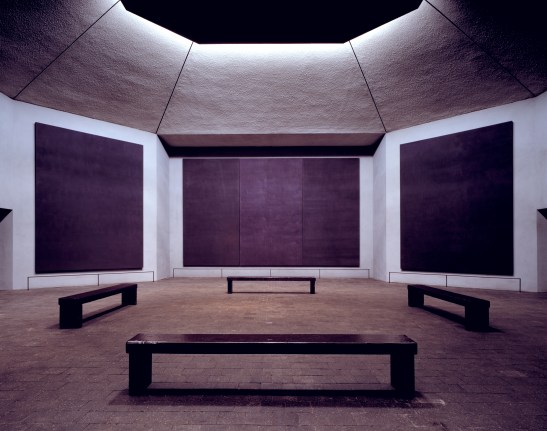
The Rothko Chapel
 Tampa
Tampa 
It bothers me that you didn’t hear back from Helen Winkler. I don’t know exactly why it should, maybe it’s just the way you wrote about it. Hmmm.
LikeLike